There are ten differences between the image above (A) and the image below (B). Can you find them all?

your happy childhood ends here!

There are ten differences between the image above (A) and the image below (B). Can you find them all?


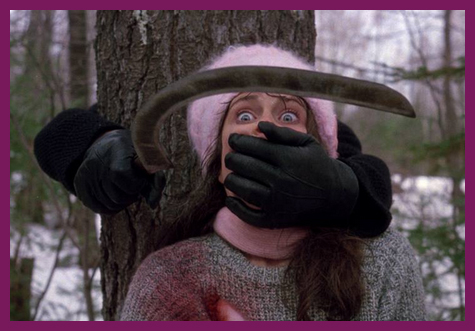
For those unfamiliar, Alice, Sweet Alice is the story of a young girl named Alice (Paula Sheppard) who everyone thinks killed her little sister, Karen (a very young Brooke Shields), at her first communion because she was jealous of her getting more attention than her. As the story unfolds and becomes even more twisted and bizarre than we'd initially expected, the audience is constantly being thrown for a loop which brings me to my 1st favorite thing about the film…

The Unpredictability – Ask a newbie to watch the first 15 minutes of Alice, Sweet Alice and then ask them to predict how the movie is going to end. They're not going to get it right. Like many films from the 70's, there's a distinct aura of "anything goes" throughout Alice, Sweet Alice. Any film that has to guts to make its first victim a child isn't playing around and it's not interested in being nice. It wants to disturb you and rattle you to your core. You're never sure who's going to live and who's going to die and when the killer is going to leap out. The best horror movies make you feel like you're in the hands of a filmmaker who's a little bit dangerous and this one definitely does that.

The colorful cast – Alice, Sweet Alice is stuffed with unique and odd character actors who all seem like they might feel more at home than on stage which gives the whole film a vibe it wouldn't have if every performance was perfectly modulated and subdued. It appears as if everyone in the film is 4 seconds away from having a hair-pulling, face-scratching nervous breakdown and it puts you further on edge. Where else would you see a character like the wicked Aunt Annie who hates her niece to a disturbing degree or the odious morbidly obese pedophile landlord Mr. Alfonso who lives in squalor with his cats and his sweat and food-stained tank top and pants that look like he just urinated in them?

The cinematography – Alice, Sweet Alice drips with mood in every shot and, while its look owes a great deal to the Italian horror films of the 60's and 70's and Don't Look Now, it still doesn't emulate them exactly. Alice, Sweet Alice doesn't really look like any other movie and no other movie looks like Alice, Sweet Alice either. It makes great use of the Patterson, New Jersey locations and milks all the production value out of every set up it can. That's just smart low budget filmmaking.

The music score – Composer Stephen Lawrence created one of the most haunting scores in all of horror history that's a far cry from his child-friendly favorites such as "Free To Be You And Me." Spooky female voices sing and wail throughout as creepy pianos tinkle and it's another part of the film that knows how to put the viewer on edge. He even said the score was supposed to act as a black cloud that had descended on the entire town and you can hear and feel that throughout.

The ambiguous ending – What does the ending of Alice, Sweet Alice mean? Even though it's a movie that's over 40 years old, I still don't want to spoil it, but let's just say that things aren't tied up as neatly as some might have liked. What does the future have in store for Alice after everything she's been through? There are many theories and that's what makes it fascinating, because everyone will have a different interpretation.

Alice, Sweet Alice was never a movie that was hard to find considering there were seemingly dozens of releases from lousy budget VHS companies. It was, however, very hard to find with a cleaned up, decent looking print. Arrow Video just recently gave the film the royal treatment it deserves on Blu-Ray and seeing it looking like a million bucks is something I never thought I'd see in my lifetime. If you've never seen it, pick up that release and, even if you have seen it, this release will make you think you're seeing it for the first time.
Note: Chris Moore's excellent film TRIGGERED is free to view on Tubi HERE!


The Legacy (1978) has been one of my favorite films since I first saw it almost 20 years ago. It's of a particular era and style that I really like. The Legacy is a combination satanic thriller and creepy old house film of the same vein as The Sentinel (1977) and Superstition (1982), two other personal favorites. The plot concerns Maggie and Pete, played by Katharine Ross and Sam Elliott, a couple visiting England on a working vacation, when a road accident leaves them stranded at the estate of the mysterious Jason Mountolive (John Standing, The Psychopath). Other guests (including Roger Daltry as Clive, a music manager, and Charles Gray as Karl, a former Nazi) soon arrive, but just as quickly start dying, and the American couple begin to expect that black magic is at work.
Here are my five favorite things about the movie:

1: The setting. Mountolive's estate, where most of the action takes place, is as sinister as it is elegant, as claustrophobic as it is sprawling. It's a haunted house without a haunting. Pools freeze over, fireplaces erupt with balls of fire, etc. These don't occur at the house's will, but at its master's. The filming location, Loseley Park in Surrey, England, exudes gothic atmosphere and is completely believable as a home to nefarious deeds and deaths.

2:Nurse Adams. I love cats. My partner and I share our home with several feline companions, and they're like children to me. And the next cat I get, I'm naming Nurse Adams. Nurse Adams spends part of the movie as Mountolive's caregiver and head of household and part of the film as his familiar, a pretty white cat with one yellow eye and one blue. (Side note: Growing up I had a cat that looked just like this one, right down to the differently colored eyes.) Nurse Adams acts as both protector of Mountolive's legacy and as a harbinger of doom to those fated to die before the weekend is out. She is the most interesting character in a film full of interesting characters.

3: The deaths. Specifically the death of Maria Gabrieli (Marianne Broome), an accomplished swimmer who drowns when the top of the swimming pool turns to glass, and she is trapped underneath the water. This is a visually stunning sequence, with shots from both outside the glass as Maria desperately bangs her fists on it and shots from within the pool as she runs out of breath and sinks to the bottom. Clive's death is also impressive, with Daltry really giving the scene is all as he chokes on a chicken bone, even though, as Karl reminds Maggie later, he'd been eating ham.

4:Maggie and Pete. I just discovered that Sam Elliott and Katharine Ross are married in real life. They met on the set of this film and fell in love. And you know what, I can see it. Elliott and Ross have excellent chemistry, and when watching the movie, you can easily tell how deeply the characters care for each other. Sure, Elliott's Pete is grumpy and spends the whole film being very, well, somewhat stereotypically American, and Ross's Maggie occasionally descends into nervous panic. But at the end of the day, these characters have each other's backs. Pete fights for Maggie when he believes she's in danger, but when she accepts her fate as the inheritor of Mountolive's satanic legacy, he's willing to share her happiness with her. Which brings to me to my final favorite thing:

5: The happy ending. I don't think I've ever seen a Satanic horror film end on such a positive note. Upon first watching this film, you really fear for Maggie and Pete's safety. You cheer for them as they try to escape the sinister Mountolive estate and worry for their lives as the other guests begin dying. But once you've seen the film once and know its ending, upon rewatching it, it seems like a different kind of movie. It almost seems like a fairytale, a Cinderella story even. Maggie, knowing nothing of her family's heritage, comes to England where she discovers herself and her history and inherits wealth and power beyond her wildest imagining. In the closing lines of the film, Pete asks Maggie what she's going to do with all her newfound power, to which Maggie replies, "Anything I want," as they stroll arm in arm across her new estate. It's an empowering ending unlike any other film of its kind. Satanism here is not Cinderella's wicked stepmother, but her fairy godmother, enabling her to actually live happily ever after.
Note: Visit Kathryngrace at Final Women for more of her perspective!


1: Norman & Mary's Relationship
Anthony Perkins and Meg Tilly apparently did not get along with each other on the set of PSYCHO II but something really clicks with them on screen and both are impeccable in their roles. Norman Bates and Mary Loomis share a generally platonic, almost familial bond, meshing together as two wayward souls both shackled to their toxic mothers. Mary is not being completely honest with Norman so there's guilt involved but the two clearly want to help each other up and out of their own personal swamps. It's complicated for sure but all in all, it's a rather touching, nurturing relationship that bypasses love interest clichés and hits the bigger target of basic human empathy. It's illegal in every state to say that PSYCHO II surpasses the Hitchcock classic that spawned it but I truly prefer it due to this central relationship that gives the film a cozy, comforting warmth that its predecessor actively avoids. You get the feeling that you're almost living with them in the house throughout the film, getting to know its rooms and layout and you can almost smell the toasted cheese sandwiches Norman speaks of. It's hard not to root for these two to somehow find a happy ending, which makes the outcome of the film even more tragic.

2: It's Beautiful
The rolling hills behind the Bates Motel are eerily postcard perfect. PSYCHO II utilizes the most beautiful background matte paintings from the legendary Albert Whitlock to wonderful effect and Dean (HALLOWEEN) Cundey's cinematography is absolutely stunning. There's an incredible God's eye view from the top of the house that takes my breath away but something as simple as a shot of a winding country road to the side of the motel can be equally striking. In the film's final moments, when we see a silhouette of an old woman approaching the Bates house framed by an almost biblical looking sky, it's a pitch-perfect visual crescendo.

3: The Slasher Effect
I'll never forget Leonard Maltin reviewing PSYCHO II on Entertainment Tonight back in the day. I think I can even quote him as saying the film "really had him" until a particularly savage gore scene ruined the movie for him. Well, I'm of another school of thought. I LOVE how this movie weaves then current slasher aesthetics throughout and think it does an excellent job blending past and contemporary tastes. Anonymous teens breaking into the Bates house to fool around, only to be attacked by a faceless killer? Yep, I've got plenty of time for that! That knife through the head kill that disappointed Len? I'll never forget how the audience roared in terror at that very moment when I saw it in the theater. It was glorious.

4: The Score.
PSYCHO II's haunting melancholy score by Jerry Goldsmith was the very first movie soundtrack I ever bought on vinyl. Goldsmith (like all in involved) had some mighty big shoes to fill. It's truly impressive how well he salutes Bernard Herrmann's original PSYCHO score while creating a distinctly more intimate mood of his own.

5: Hitchcock's Cameo
Hitchcock was known for making a brief appearance in his films so it's no big surprise that his ghostly profile should appear in PSYCHO II. These days it's no big deal when a film winks or subtly references another and you'd almost have to expect a nod from a sequel to such a classic. Still, I'll always love this subtle tip of the hat because it may be one of my earliest memories of appreciating a cinematic Easter egg and wondering if others had caught it too. I always look forward to this particular moment when I watch the film and it never fails to give me a shot of nerdy glee. Director Richard Franklin and writer Tom Holland couldn't have done a better job respecting and saluting Hitchcock's masterpiece so I'd say the inclusion of Hitch here is very well earned. It's just one of the many reasons watching PSYCHO II will always feel like coming home to me.


Note: Michael can also be found at The Retro Movie Love Podcast & The Last American Video Store Podcast
DEATH WISH CLUB (1984)
AKA: THE DARK SIDE OF LOVE
AKA: GRETTA
AKA: CARNIVAL OF FOOLS
DEATH WISH CLUB has many titles, but I've always gone by the title I discovered it as a kid with a Video Store card and a dream way back in the ‘80s. The clamshell VHS cover led it on to be a James Bond-ish karate Film with some gambling, and boy oh boy is this Movie not that. It's the kind of Movie that I like to show people just to gauge what kind of reactions they have. Some have told me it was the weirdest Movie they have ever seen. Others have dismissed it as low budget trash. Either way I'm fairly sure they won't be forgetting it anytime soon. Nor should they! I've always championed this Film but its cult seems to be pretty small. Some will remember scenes from it in the compilation film NIGHT TRAIN TO TERROR (1985) but that doesn't do this Movie justice. You need to experience the entire Film from beginning to end. You need to meet Gretta.

5:This crazy and unpredictable Movie was written by the same person who scripted EL-CID, KING OF KINGS and JOHNNY GUITAR. Look up Philip Yordan's credits and you'll see a lot of great genre Films of the 40s, 50s and early 60s. I love that some old dude in the ‘80s decided it was finally time to write a Movie about a young man who falls head over heels about a woman who does porn, has a split personality and is involved with an older rich man who is part of a club where people play elaborate games of russian roulette. I wouldn't even begin to crack the plot of this. My friend Amanda Reyes (of Made for TV Mayhem) mentioned to me after I had her watch it that it reminded her of David Lynch. I would say that is a fair assessment. I think Mr. Lynch would enjoy this Film.

4:Merideth Haze. The performance of Merideth Haze has to be seen to be believed. This is go for broke. This is what actors need to be studying in class. Merideth sadly only starred in this one Film and then disappeared into the ether. You'll never meet a character like Gretta/Charlie White in Film. I would love to, though. I want to know why she thinks she's a fish when she takes a bath. I want to know why she is glad Chopin is dead. I have so many questions for her.

3: The lead character Glen is a college student who has an aunt who visits him at his job at the morgue and likes to check out dead corpses' junk. Glen is played stiffly by Rick Barnes (who only showed up in one other Movie – MARILYN ALIVE AND BEHIND BARS (1992) by the same director, John Carr). I don't know why the writer and the director felt this was necessary but it's a touch that only makes any kind of sense in the framework of this crazy pants Movie. I also love that Glen, when pining for his lost love Gretta, goes to the Movies and you see him staring sadly at a poster for John Carpenter's THE THING (1982). This is a Movie that has it all. Naturally Carpenter's THE THING makes some sort of appearance.

2: The unexpected dive into the world of porn, sex shops and jazz clubs. There's something about the worlds these characters inhabit. I haven't even mentioned the actual Death Wish Club itself. There's so much other stuff happening in this. There's a Tanzanian winged beetle in this Movie. But yeah, when you do see Gretta on the set of an adult Movie it's like, what the hell is going on. Something about a mad doctor who is switching brains? Sure, why not. Let's go with it. Glen's visit to a sex shop where he gets the hard sell for lube, toys and more pleasurable items is pretty hysterical. Did I say this Movie is pretty funny? I find it funny at least. Maybe it's just my warped brain. And yes, Gretta is a jazz pianist at the "Club Manhattan". This is where Glen first lays eyes on her. The poor guy will never be the same again.

1: The mysterious case of Gretta/Charlie White. Since JUST ONE OF THE GUYS (1985) is practically my all-time favorite Movie, it's natural that I love the left field idea of Gretta turning into Charlie White. The Movie poses many wacky and out there ideas, but none greater than an apparently dead Gretta who then resurfaces as a man named Charlie White. And not just a guy named Charlie White. A guy named Charlie White who most of the time sounds like he's in a ‘30s gangster picture. He's even chomping on a cigar in a scene. Why? Why not! Ultimately Glen needs to stop Charlie White, THE GRADUATE style, from getting married. He does this with his expert use of karate. Now you'll finally learn why there is martial arts on the VHS cover. Will we get to see Glen and Gretta unite? Will Charlie White stick around to the end or will he be exorcised by the sheer power of Glen's penis? Will Glenn & Gretta survive the DEATH WISH CLUB? Will you?
Now imagine seeing all of this as a kid in the 80s. Hey, i'm fine. How are you doing.


The Double (2013)
F. Scott Fitzgerald wrote that "in the real dark night of the soul it is always 3 o'clock in the morning, day after day." Likewise, THE DOUBLE takes place in a world that's one long graveyard shift. You never see daylight, it's always dark and gloomy. This adds to the hero's heightened sense of loneliness (which is ironic because he meets his doppelgänger.) THE DOUBLE is a comic nightmare and it's very funny, but there's also some psychological horror about identity. Jesse Eisenberg's dual performances are outstanding. Director Richard Ayoade's comic timing brings life to this story, based on a novella by Fyodor Dostoyevsky. Part of the comedy comes from the bizarre situation that no one else sees the physical similarities between these two look-alikes. So, there's a question of whether or not the hero is cracking up and experiencing a profound delusion. Horror fans will likely connect with the bleak material and the Kafka-esque anxiety running throughout the film. Bonus: you might find similarities to BRAZIL and TAXI DRIVER.

Rhinoceros (1974)
Making a film version of Eugene Ionesco's theater-of-the-absurd play RHINOCEROS is a losing proposition. Stage productions benefit from suspension-of-disbelief, audiences can meet the actors half-way, using their imaginations to see the human characters transform into rhinos before their eyes. It doesn't translate to film. For better or worse, the 1974 movie makes no attempt to use any special effects to show that transmogrification. Theater people will point out that this film is not funny. Fair enough. But genre fans might enjoy it as a horror movie. First off, you've got Cronenbergian body horror, with people morphing into pachyderms. Then there's an INVASION OF THE BODY SNATCHERS vibe (complete with political subtext) of a hero seeing his friends and neighbors assimilating into a non-human form. Lastly, there's the I AM LEGEND angle, with Gene Wilder as the last man on earth. During these pandemic times, it's fascinating to watch the terror of RHINOCEROS, where the planet's dominant species is bringing about its own destruction. Bonus: lovers of ‘70s cult movies will enjoy seeing a peak Karen Black performance. And Gene Wilder might surprise you by playing a character that's different from the "gentle madman" persona that he perfected elsewhere in his career.

Martha Marcy May Marlene (2011)
The trailer is hitting all the buttons to tell you it's an "indie", it's "art house", it's "very Sundance." All true. But you can watch MARTHA MARCY MAY MARLENE as a scrappy horror movie. It reminds me of early Wes Craven films. Like LAST HOUSE ON THE LEFT, it's thematically comparing two very different families. Elizabeth Olsen plays the title character, a traumatized young woman who leaves a cult and tries to reunite with her estranged sister. Olsen is fantastic, never going too big or melodramatic while going through a breakdown. Martha is like a "final girl" detoxing from a nightmare, unable to distinguish between what's real and what's vividly imagined. Writer-director Sean Durkin uses the camera to play tricks on the viewer, toying with memory and reality. Intentional ambiguities ratchet up the tension and create a hypnotic undertow of dread. All this, plus Sarah Paulson plays Martha's brittle, guilty sister. And there's my favorite John Hawkes performance as a believable cult leader who sings a haunting folk song. Bonus: water-as-memory imagery, for fans of SHOCK WAVES, DON'T LOOK NOW and STEPHEN KING's IT (1990).


Ghost Story remains a film I champion year after year, decades on. I remember being so affected by it the first time I saw it, for a multitude of reasons. Full disclosure: the source material it is adapted from is my favorite book and has been since I was a young teen. Peter Straub wrote a complex, dread-inducing tale that was layered with moments of true terror, so imagining it being put to screen had me feeling both incredulous and terribly excited. So despite the changes from page to screen, I still am quite passionate about the film!

1: The first class casting —
When adapting a book about a quartet of old men in New England who've grown up together and known each other their whole lives, you better get a damn good cast. And that they did. John Houseman, Douglas Fairbanks Jr, Melvin Douglas, and Fred Astaire form the Chowder Society – a group that gets together in their finest black tie to share ghostly tales by the firelight with brandy on stand-by. Sounds great until you find out they've been harboring a devastating secret for over 50 years- one destined to tear them apart. The book featured five men, so not sure why they decided to leave one out…perhaps Jimmy Stewart was not available? Anyway, I digress. Also part of the ensemble is Craig Wasson as David/Donny, who is able to hold his own quite hardily with all those lauded and distinguished old gents. But paramount to the film is the casting of Alice Krige, who completely owned the dual role of Alma/Eva. Her enigmatic yet lovely, old-fashioned girl juxtaposed with the embodiment of pure evil is what carries the entire film. When her past with Edward, Sears, Ricky and John is revealed, there is no stopping the revenge she has planned. To me, she is one of the most vengeful and spectacular ghosts in film.

2: The dual time periods–
The film starts with the four elderly men having debilitating nightmares and it doesn't take long for us to discover that they are all living with a decades old secret that is rearing its ugly head. When Edward dies, his son Donny is left with the task of discovering his father's shrouded past and relating it to his own recent horrifying experience. Donny reveals to the three remaining friends in flashback scenes that he met and dated a beautiful college secretary named Alma when he lived in Florida, but that the relationship continued to decline due to increasingly strange behavior and an almost unearthly obsession with Donny's home town, including his father and his friends. Describing the unnerving circumstances causes the men to unravel, and that is when we relive a summer in their college years in which they courted a wealthy yet mysterious socialite name Eva Galli. Something SO awful occurs it is to the men, unspeakable, but it sets in motion a course of events that haunts them into the present. It's obvious that their misguided and disastrous past has caught up with them. The movement between time periods is absolutely crucial to the storyline but isn't done in such a manner that confusion sets in. As answers begin to reveal themselves, the past and present collide in a catastrophic final act.

3: That house!! —
A character in and of itself, the Victorian mansion in Ghost Story is one part stunning, one part sinister. It's probably my favorite house in horror, and in the present time in the film, in all its decaying beauty, it leeches into the soul and stays there. With peeling wallpaper, deteriorating floorboards, broken windows and crumbling facade, it is one of the best examples of a stereotypical "haunted house". Combined with the snowy New England setting, it's tough to beat for a truly frightening visage. In the scenes set in the past, the grandeur of the stylish home and all its Victorian-era fine furnishings camouflage the rotting ediface it has become in the present. Perhaps most comparable to the house in Psycho, it's no wonder it's such an important part of the story. In the climax where Alma is descending the crumbling staircase and the decrepit house is dripping water down the walls, the stench of the decay can almost be smelled through the screen. This is where Ghost Story is at its most gothic, most horrifying best.

4: The special effects and soundtrack —
The incomparable Dick Smith (of The Exorcist fame) was on hand with his team to provide the ghastly and gruesome effects for our Ghost Story, and believe me, it shows! I can't express how good the practical effects are here. While other effects magicians were getting a lot of praise and work, particularly in the fabulous horror year of 1981 when this film was made, matching the talents of Smith would be difficult to say the least. There are multiple visages of Eva/Alma here that are stomach-churning delights, from an icy death mask to a decaying, rotting corpse to a decomposing skeletal hand to a skin sloughing off the bone last reel shot….it's so great! Besides the gory effects there are subtle visions of ghostly images hidden in bushes, a bathtub jump scare you can see coming but are powerless not to be affected by, and of course the aforementioned house itself. With the two time periods there was a lot of costume design and set design that came into play and felt so authentic.

I would be completely remiss if I didn't mention the fantastic score by prolific French composer Philippe Sarde as an effect itself. I'm not sure how he ended up scoring this movie but I'm sure glad he did. The music over the opening credits is simply incredible, I really don't think it can be compared to any other film score, it is just that good. Each musical movement parallels the story being told and works with the action on the screen, fitting like a well worn glove. The strings, woodwinds, and organ play a big role, and in particular the last part of the score entitled appropriately, Finale, has a haunting vocal at the end that might be my favorite piece of music from any film score, and that's saying a lot as I am an avid collector of scores. Very hard to find and purchase in any format, you can still take a listen on YouTube if you're interested.

5: The atmosphere — Dread.
Pure dread. Mistakes made in their youth come back to haunt our four friends, and what comes for them is pure malevolence, and it's felt in nearly every moment on screen.  Not a movie full of a lot of blood and guts nor an action-fest, Ghost Story takes its time with the viewer, setting up an ominous chain of events from which there is no return. The cold winter chill and snowy landscapes of Vermont (Saratoga Springs NY standing in for the Freedom and Unity state) settle around everything in its path, where you can almost feel the ghost's cold breath on your neck. It always seems like the creepiest shit happens in small towns, and little Milburn, Vermont is apparently no different. At the start of the film when we are listening to Sears (Houseman) tell his monthly spook story to the other three men, the lights are low and the red cast of the fireplace spotlights the fear in each man's eyes and sets the tone for the rest of the film. It's immediately evident that the intent is to scare the pants off of viewers. The men are at once on edge and it continues with no real stop the whole way through. The movie is wrought with tension that you could cut with a knife, which is unsettling and let's face it, disturbingly delicious. Isn't that why we watch these films in the first place??
Note: Visit Christine at her home base Fascination With Fear HERE!


My two favorite genre films are Fright Night (85) and Night of the Creeps (86). Both are similar in their Those-Who-Came-Before homages, but differ greatly in tone; however, both remain in a perpetual tie for first place in my head. Mickster did a great Five Favs on Fright Night, so I am going to give my five for the latter. I will list them in order of least to most favorite thing. *SPOLIER ALERT* Number one is Tom Atkins.

5: The Character Names
Chris Romero, James Carpenter (JC) Hooper, Cynthia Cronenberg, Det. Ray Cameron, Det. Landis, Sgt. Raimi, and Mr. Miner. I don't need to tell any of you what those names mean. Oh, and the first three all attend Corman University. Fred Dekker obviously loves his chosen field, and even more he loves the people who helped to build his chosen genre. In fact, he goes out of his way to pay homage to the giants upon whose shoulder's he stands. The entire movie is Dekker's love letter to the sci-fi b-movies he grew up on. Opening in a flashback, a rogue alien aboard a UFO launches a canister into space, only for it to fall to Earth- specifically, right into 1959 middle-America in the backyard of Corman U. Meanwhile, two clean cut American teens are making out in a sweet-ass convertible. Following the path of what they think is a meteorite, they run into a recently escaped axe-wielding maniac.

As poor Peggy Sue (Sure, let's call her that.) is being diced like an onion, her boyfriend finds the canister in a smoking crater. Space slugs fly out of it and into his mouth. Smash cut to 1986 Coman U., and Chris Romero (Jason Lively being as perfectly him as only he can.) being moody over unrequited love. His pal, JC (Steve Marshall giving some real heart to what would be just another comic relief role for other actors.) is providing solace with promise of others girls and parties to come. Before we know it, our heroes are accidentally thawing the corpse of our slug swallower from the opening, as he has been cryogenically frozen by a scene stealing David Paymer.

Why? Who cares? The point is, Dekker now gets to pay homage to the zombie films he also loved, as the slugs start inhabiting people's brains, turning them into living dead pollinators. As more people are infected, the more fun we have watching the protagonists get stuck in tighter and tighter spots. By the movie's end, we have been treated to not only the above mentioned homages, but there are easter eggs galore, including a Dick Smith cameo (More on that in a minute.), slasher tropes, Plan 9 playing on a television set, and not one, but two references to Dekker's other cult classic/my Goonies, The Monster Squad, which would not be released until the following year.

4: "STRYPER RULES!"
JC is hiding in a bathroom stall while the floor teems with space slugs hungering for his meaty cerebellum. There, clearly over his shoulder is the graffiti, "Stryper Rules!" The story goes that this was done as an in-joke for makeup artist Kyle Sweet, who was then dating and would later marry Stryper front, Michael Sweet. I am not a Christian, but I am a metal fan, so there's no way I should like anything about Stryper. However, in 7th Grade, I had a crush on Bev M, and she was a member of one of those churches that do moralistic haunted houses for Halloween. So, I went to a Stryper concert with her youth group just to hang out with her. I don't remember a ton about the show, other than it was the only metal show I have been to that had not one but two prayer breaks. Anyway, seeing that graffiti always takes me back to that time during my misguided youth when I could have gone down one a path that led to conversion camps and belief that Halloween was satanic, but in a bad way. Thank Buffy, I went the other direction.

3: The FX:
We all know that when it comes to splatter, we want to see that oversaturated, red corn syrup magic potion that is so much more satisfying than the pixelated cartoon blood used in modern monster movies. Not only that, but if a head splits open to spill a bunch of space slugs onto the ground, isn't it better when we can hear them plop satisfyingly to the earth? Only horror fans can truly appreciate FX from the team of makeup artists including Howard Berger (Day of the Dead, Evil Dead II, Misery), Robert Kurtzman (The Walking Dead), and David B. Miller (A Nightmare on Elm Street). When the blood flies in this one, you can almost feel it sprinkle across your face. Close up shots of zombie Frat boy faces cracking in two while viscous fluids (Likely corn syrup and K-Y Jelly, standards of the Horror FX toolbox.) stretch between the dividing cranium, slimy slugs dripping with more gross liquids slither across tile floors at breakneck speeds (Sure, you can see the pull wire in a lot of the shots, but that's just part of the charm.), and skeletal axe murderers on the prowl are just part of the practical FX that all horror fans seek. Zombie dogs causing major bus accidents are just the icing on the gore covered cake.

2: It's a Bonified Walter Paisley Movie:
When I was around 14, I was reading a Fangoria article about the Corman produced, Wynorski helmed cult classic, Chopping Mall. In it, they casually mentioned Dick Smith "once again appearing as Walter Paisley." It caught my eye. What did they mean by "once again?" That's when I found out about the oddity that is Walter Paisley. In the days before Google, I dug through old periodicals in our small-town library looking for any references to Corman movies, and particularly to Walter Paisley. Eventually, finding articles from underground newspapers in exotic locales like Philadelphia, Chicago, and San Francisco that friends would mail to me. Piecing it together, I found five movies in which he appeared as Walter Paisley, a number that would go up by one when I saw NotC in the theaters as a teen, and by one more when the World Wide Web opened: The aforementioned CM, A Bucket of Blood, Hollywood Boulevard, The Howling, Twilight Zone: The Movie, Shake, Rattle And Rock! (TV), and the movie that this article is about. None of the characters were similar in anything but name, and one occasion of career overlap. (He plays WP as a cop in both Shake and NotC.) It was such a bizarre notion to me, that it became one of my favorite things about the entire genre. Horror doesn't just push our sensory boundaries; it also bucks the norms of narrative storytelling. You'll never see a Walter Paisley in a rom-com, no matter how much we all want it.

Knowing much of this before NotC was released made seeing it in the theater that much richer for me. When Tom Atkins, JL in tow, go to the police equipment room and call out a hello to Walter, then we see a close up on Dick Miller sporting a nametag that said, "Offc. Paisley," I was in on the joke. I immediately leaned across my friends, attempting to explain why I had laughed, only to quickly see that they didn't care. So, it was my own little joke, and my heart grew three sizes that day, all thanks to this movie.

1: It's Tom FREAKING Atkins:
It's Tom FREAKING Atkins.
You must be logged in to post a comment.